
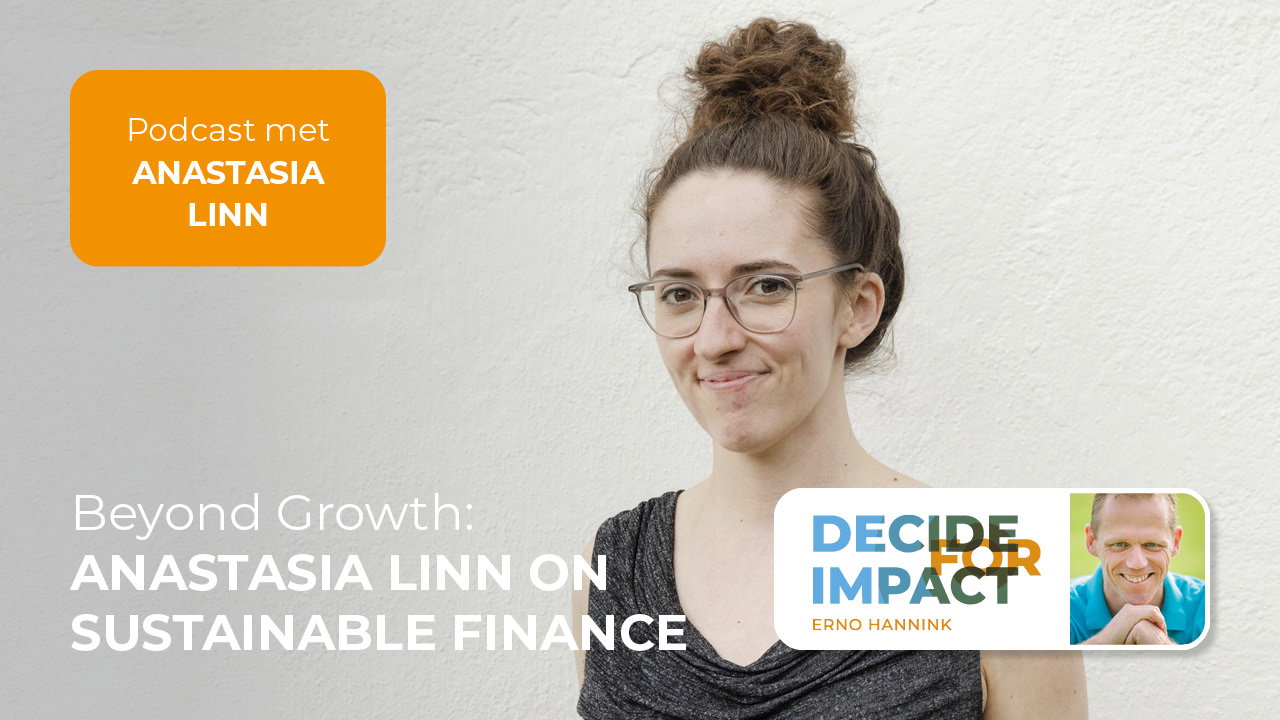
Is the way finance is set up the root cause of our faith in growth? Banks that create money out of thin air. Interest that requires growth somewhere in the financial system. This was one of the topics in this conversation with Anastasia Linn. Her answer surprised me.
This conversation got me thinking about blame and accountability, about sustainable finance: is it even possible, and energy from your work and at the same time protecting your own energy.
Today, we are learning from Anastasia Linn.
Anastasia works at the intersection of organizational behavior, finance, and the Just Transition. Before co-founding Arketa Institute for Post-Growth Finance, she worked at organizations like the Center for Sustainable Finance and Private Wealth, World Climate Foundation, and the House of Beautiful Business. She initiated the Exploring Postgrowth Finance project at Degrowth Switzerland and has worked across the areas of leadership, innovation, and sustainability since 2016.
Genuine sustainable finance is finance that can enable wellbeing for all within planetary boundaries.
Let’s get started…
In this conversation with Anastasia Linn, I learned:
- 00:00 Intro –
- 02:15 What does Arketa stand for, and what does the business do?
- 05:25 Ecological economics vs. neoclassical economics.
- 10:45 The responsibility of finance and banks (money creation) for our obsession with growth and deciding what is made in the economy.
- 13:50 The incentives within the system to accumulate money and power to be safe and deeper cultural issues.
- 17:10 Conversations with financial professionals to get into the underlying cultural change.
- 19:30 Wealth equals happiness, and material goods are necessary to feel pretty, powerful, respected, or loved.
- 21:25 Surprised and disappointed by where the sustainable finance conversation was.
- 24:00 Even people who self-identify as committed impact investors are not willing to pay slightly more for exponentially more impact. (see https://doi.org/10.1093/rfs/hhac066)
- 27:25 Sustainable and traditional investors are basically indistinguishable because they are applying the same logic (see paper by Edmans and Gosling below).
- 29:25 Do we want rich families from Europe to own the fresh water infrastructure in Sub-Saharan Africa? You are fulfilling a real need and at the same time extracting profit to Europe.
- 33:55 How her new business created a place for all that energy to go. The point is to care for herself enough to sustain that energy long term.
- 34:40 How can I embody our namesake of enoughness and make enough space to take care of myself?
- 40:15 The attention for the work and the paper of Arketa in the finance world is much more than she anticipated so soon.
- 41:05 When people realize that they are not alone, it makes it safer to take the next step.
- 45:00 The income streams for Arketa.
- 46:05 Do you need to be privately wealthy to try to work in Degrowth?
- 51:00 How do we want to manage accountability for centuries of maltreatment?
- 52:40 Blame is an easier position psychologically.
- 58:15 Going back to university to study psychology.
- 1:02:35 Exist at the intersection between the two systems, play by the rules a little bit, and stay connected to the new world.
- 1:07:30 Examples of exciting things that are happening at the fringes of the financial world. Progressive wealth holder movements like Patriotic Millionaires, Millionaires for Humanity, Good Ancestor movement and Research generation.
- 1:08:40 The growth independent financial system.
- 1:09:05 Examples of what individuals can do with their personal finance: financial activist playbook, Bank for Good, Triodos (NL) and the divest movement.
I admire her wisdom and you can see and hear this particularly from 30:20 to 35:35 is really interesting and important. What she shares is, for me, one of the main reasons to work with the Inner Development Goals.
More about Anastasia Linn:
Reports and papers by Arketa:
- The first report, an introduction to Ecological Economics and Degrowth, and what it means for finance: By Disaster or Design
- The pension paper: A Path to Post-Growth Pensions
- Impact report 2025
Resources shared by Anastasia:
- Jasmine Rashid’s Financial Activist Discussion Zine
- Miho Soon’s podcast Money Trauma
- FEBEA (European Ethical Banking Network) + Bank for Good Europe + US
- Renee Lertzman’s Substack, Becoming Guides
- The Hidden Business Majority: From Private Support to Post-Growth Transformation Report from Jeni Miles, Dario Krpan and Fred Basso at the London School of Economics
- Hans Stegeman, Chief Economist at Triodos Bank, has a Substack where he often talks about post-growth, degrowth, and wellbeing economies—definitely worth following.
- An intro to progressive wealth holder movements from Michael Gast (US focus) + Also check out Good Ancestor Movement and the We Must Draw the Line coalition on reducing extreme wealth inequality.
Resources we mention in the conversation:
- Not-for-profit businesses as an alternative – Jennifer Hinton
- De nieuwe economie in de praktijk – Heidi Leenaarts (Dutch – on money creation)
- Geld genoeg, maar niet voor jou – Thomas Bollen #boekencast afl 135 (Dutch – book on money creation process)
- Money creation – Wikipedia
- Steve Rocco (colleague and co-founder)
- Belonging, Identity, and Decolonizing from Within – Zulfia Abawe
- A connecting perspective on colonization – Rukmini Iyer
- How to fix the economy – Mariana Mazzucato interview | The Exchange
- Tom Gosling – Professor in Practice at the London School of Economics
- Alex Edmans – professor of finance
- Paper: Sustainable Investing: Evidence From the Field by Alex Edmans, Tom Gosling and Dirk Jenter
- Do Investors Care about Impact? paper by Florian Heeb, Julian F Kölbel, Falko Paetzold, Stefan Zeisberger, Do Investors Care about Impact?, The Review of Financial Studies, Volume 36, Issue 5, May 2023, Pages 1737–1787, https://doi.org/10.1093/rfs/hhac066
- REAL – A Post-Growth Deal
- Planet Finance (Dutch)
- Patriotic Millionaires
- Millionaires for Humanity
- Good Ancestor movement
- Resource Generation
- Ethical banking movement
- Academic advisory board Arketa
- The Financial Activist Playbook by Jasmin Rashid
- Bank for Good Europe
Video of the conversation with Anastasia Linn
Watch the conversation here https://youtu.be/9TGDn3K0aNs
Summary (created with AI)
Host Erno Hannink interviews Anastasia Linn, co-founder of the nonprofit Arketa Institute for Post Growth Finance (“arketa” meaning “enough” in Greek), which aims to normalize finance-industry conversations about limits to growth and develop ideas for growth-independent finance grounded in ecological economics rather than neoclassical economics.
Linn critiques mainstream sustainable finance and tools like ESG integration and impact investing as largely embedded in the same extractive logic that drives inequality and ecological overshoot, and discusses how bank money creation and lending criteria reinforce growth imperatives and unequal outcomes.
She explains her path into sustainable finance via science communication in Switzerland, describes how the work energizes her while requiring self-care, and notes Arketa’s early traction with industry audiences despite limited funding.
They discuss accountability versus blame, the need for credentials to bridge systems, and encouraging movements such as ethical banking and progressive wealth-holder redistribution, plus practical individual actions beyond financial capital.
Transcript
[00:00:00] Erno Hannink: Today you’re listening to the conversation with Anastasia Linn. Anastasia works at the intersection of organizational behavior, finance, and the just transition. Before co-founding Akata Institute for Post Growth Finance, she worked, , at organizations like the Center for Sustainable Finance and Private Wealth, World Climate Foundation, and the House of Beautiful Business.
She initiated the Exploring Post Growth Finance project at Degrowth Switzerland and has worked across the areas of leadership, innovation, and sustainability since 2016. It was a wonderful conversation, and I’m so grateful for the wisdom that Anastasia shared and showed in this conversation, and I hope you enjoy listening to this conversation as much as I did during this conversation.
My name is Erno Hanoink, and I share my knowledge, expertise, and experience with you. I coach entrepreneurs to make better decisions that will help them to grow their impact. Let’s get started.
Welcome to this new podcast ep- episode. Today I’m talking to Anastasia Linn. Welcome, Anastasia.
[00:01:34] Anastasia Linn: Thank you so much.
[00:01:35] Erno Hannink: Or, or Anastasia.
[00:01:38] Anastasia Linn: Yeah, either is fine.
[00:01:39] Erno Hannink: Yeah. We’re gonna talk about a lot of things. We’re gonna talk about, you know, post-growth, degrowth, green finance, and stuff like that, so when you’re listening you have, like, an idea where we’re going.
But we’re gonna find out more about what you do because let’s go start from Arketa, your business. What does it stand for and what does it do?
[00:02:02] Anastasia Linn: Yeah. So first off, I’d say we consider ourselves a think tank. We’re a nonprofit in the US, and in the process of establishing ourselves as a association in, in Switzerland, so just a small distinction.
We’re not really a business as such. That being said, Arketa, our namesake word, means enough in Greek. So our full name is Arketa Institute for Post Growth Finance, and we kind of liked picking up that word because we’re talking about enoughness in a number of ways. We think that there are objectively enough resources for everyone to live a good life within planetary boundaries if we choose to do so, and, and set up systems that enable that.
And we also think it’s, uh, a little bit provocative, which is appropriate for what we do because we’re kind of saying enough to business and finance as usual. So to answer the second part of your question, what we do, our primary purpose at the moment is to normalize conversations around the limits to growth in finance.
So we talk a lot about, um, the economic paradigm, so theoretical sort of school of thoughts that’s really well established, not just in finance, but in business schools all over the world. It’s basically considered when people think economics or when they take a Eco 101 class, they learn neoclassical economics.
I know you’ve had, uh, say Jen Hinton on before or other people that have maybe talked a little bit about this, but just for clarity, neoclassical economics is basically focused on kind of market mechanisms like, uh, supply and demand, and in some of our presentations we use a simplified version of that model which shows, like, supply and demand, uh, going between households, uh, and firms.
Sort of around, around, around, around like a perpetual motion machine. The only thing that connects it to, say, human needs or… I mean, human needs are often considered to be infinite in that model. But the only thing that connects it to our environment is this idea of externalities, which is kind of tacked on to account for, “Oh, wait, bad things also happen.”
We have, like, these sort of unintended consequences, uh, from just, like, markets happening as they do in this model. So that’s a simplified version, but it’s sort of easy way to think of it. And basically, all of finance as we know it today, including so-called sustainable finance, is built on that paradigm because it’s what people learn in university.
If you study business or finance of any kind, that’s, that’s basically the, the theoretical framework that you’re equipped with in university or wherever else. And we– I guess I can, I can speak a little bit more about some of the shortcomings of, of sustainable finance as usual later. But, um, as three people working in the finance industry that had sort of seen these shortcomings in the presence of things like planetary boundaries being like, “Okay, if the planetary boundaries are flashing red, clearly we’re not doing something right.”
We see ecological economics as an interesting way to change the conversation. So basically, to intervene at, at this, I mean, seemingly theoretical level of like, okay, it’s just a difference in two– you could say it’s a pedantic difference between one academic school of thought and another, but it’s one that is very, very important for the kind of financial system that we build, because one of them, ecological economics, takes matter and energy and waste into account from the beginning, and the other, neoclassical economics, does not.
And basically, if we have physics and chemistry built into our model from the beginning, we still don’t have a full representation of all the complexity of, of the world and its, its many systems, but we’re much closer to something that we think could work in the twenty-first century and something that we think could serve as a basis for genuinely sustainable finance.
And what do we mean by genuinely sustainable? We mean Finance that can enable wellbeing for all within the limitations of our planet, so within planetary boundaries. And that’s the work that we do at Archita Institute is basically to open these conversations among our peers in the finance industry.
It’s a bit of a taboo to talk about the limits to growth because, as you can imagine, finance is a very growth-oriented industry, even more so than business as usual, and that’s sort of saying a lot, um, because that’s one of the primary deliverables in many situations is that you deliver growth. It’s, like I said, taboo or kind of understandably scary or threatening to start these conversations in many cases, even though in our experience so far, many people are having them behind closed doors or in one-on-one conversations.
But to get to the point where you really have a conversation about it as an organization or even more so have that conversation in a way that the outside world can interact with, that’s very, very hard, and there’s, there’s not a lot of people in our industry that are doing that yet. Uh, having the conversations internally, yes, but coming out and talking about it in ways that, like, can help us find solutions together, less so.
So basically, a lot of our work is around how we can make that easier for our colleagues in the finance industry, and part of that is by, by breaking the taboos. The other is, like, by starting to generate ideas around what growth-independent finance could look like.
[00:08:17] Erno Hannink: S- that’s always in the beginning of the conversation and when, like, you start talking about what you do, there’s so much information coming towards me that I-
I, I don’t know where to go. Yeah. Um, I, I have, I have so many thoughts right now because the first thing I thought, do we really need a think tank, right? Do, is that, is that really important that we need more theory on stuff? Do we need more information and documentation? Before you answer, um, th- because– And then the second thought happened, um, in the background was, oh, I’d remember that in Austria, the whole thinking about- How the new economy way could be, the neoliberalism, uh, started, like, in the ’70s.
Mm-hmm. And it took, like, a couple decades, I believe, before it was really effectively implemented. So I kind of, like, answered my own question saying, “Yeah, it is important- … that we do this, ‘cause this is how things work.” But on the other hand, I also see that if you look at sustainability, for example, there’s a lot of conversations going on.
And despite the willingness of, like, 78%, I believe, from the people say that they really believe that y- we’re going the wrong direction, we need to change things, we are not, right? Our actions s- don’t say the same thing. And I, I think a lot has to do with how we feel that others are responsible for this, the, the effect that we’re experiencing today.
And bringing that back to finance, so I know, know I am saying a lot, right? To be clear. So but bringing it up to finance is when you were talking about how growth is embedded into finance-
[00:10:10] Anastasia Linn: Mm-hmm …
[00:10:10] Erno Hannink: is then finance possibly the root cause of everything with- … growth? Because the, the, the need to get, like, a, a dividend of the money that you invest-
[00:10:23] Anastasia Linn: Mm-hmm
[00:10:24] Erno Hannink: requires a growth from somewhere by somebody.
[00:10:27] Anastasia Linn: Mm-hmm.
[00:10:28] Erno Hannink: How do you, how do you, how do you reflect on this?
[00:10:31] Anastasia Linn: Yeah. Yeah. So for the last part of your question, there’s definitely some thinking around that, and it has to do with money creation. So the fact that we have, like, fractional reserve banking and the majority of the money that’s floating around in today’s systems, uh, wherever you are, is created not by the government, but by banks, by lending.
So I won’t get too deep into that, but we can put some explanations of that process maybe in the show notes. But basically, there are ways in which that process of money creation, it inherently creates some growth imperatives, you could say, because a bank… Well, it, it, it’s actually, it’s not just creating growth imperatives, it’s also deciding what’s made in the economy, right?
Because this is banks deciding who should get loans, and their decision criteria, and this is for, like, mainstream commercial banks, not ethical banks or, yeah, say, very sustainability-oriented banks. They have other decision criteria. But for the most part, the idea is who’s gonna be the safest bet? Where can we put our money that we have the most likelihood to get a solid return on investment?
And unfortunately, or because of all these various factors in the system, typically, the safest bets are the projects that already have more money or already have, let’s say, access to traditional forms of power within the current system. And in a degrowth or wellbeing economy-oriented mindset- It’s sort of the opposite of where we would be putting the money, right?
In, in a degrowth mindset, we would be saying, “Okay, we wanna invest in projects that enable people to live well within planetary boundaries. We want everyone to have access to housing and food and healthcare, and the things that make life possible and worthwhile.” And in the mainstream mindset of today, it’s more, “Let’s definitely build those luxury condos because rich people are gonna be more likely to pay us back.”
So w- rich people that, that buy the apartments or rent them are gonna be more likely to be able to pay back the property management company or housing developer that built the condos that will then pay back the bank. So it’s exactly the opposite of, of what we might want from a wellbeing economy perspective.
And indeed, I think there are ways in which that system perpetuates or accelerates, uh, this growth mindset within our economy. That being said, though, I don’t think that we could say that finance is the root cause of these issues. I see it more as a accelerating force. So there are these incentives within the system to accumulate wealth and power to be safe, and there’s deeper cultural issues, let’s say that are perpetuating that, right?
The idea that I should have more for myself so that I can protect myself against others, rather than saying, “We’re actually stronger and safer if we do this together.” So that’s a deeper underlying cultural- perspective or outlook, let’s say mindset kind of Based on ideas of separation and ideas of, like, human exceptionalism or, you know, structures of power, like the idea that hierarchies are okay and can exist among different kinds of people or this sort of thing, that they’re justified.
That’s something that’s deeper than the infrastructure of finance. But if we take all of that together and we say like, “Okay, we have separation and human exceptionalism and ideas of accumulation or justifying current power structures,” and we build a financial system based on that… I mean, you have an economics based on that, which is neoclassical economics that says, “Oh, it’s okay, like, as long as supply and demand is going around, like everyone will get a piece of the pie in the end.
We just, like keep growing and growing,” and this sort of typical neoliberal idea. But it’s justifying those– it’s justifying further extraction. It’s, it’s like economics based on those ideas. And, and finance, my colleague and co-founder, Steve, he says often like, “Finance works as designed.” Finance itself is fine if you accept what it’s built on, which is neoclassical economics, and we don’t.
So finance is, is built on top of that, and the way that it works makes sense if you see that it was built on all these other dynamics. But in the context of wanting to move towards an economy that is more caring and recognizes embeddedness and wants to pursue sustainability, which is like some form of perpetuating life on earth in a more balanced and desirable way, if we want that, we won’t be well-served by tools that were built on these other systems and ideas that are inherently extractive or, uh, perpetuating inequality effectively by design because they weren’t built to not do that, if that makes sense.
We think that it’s certainly a key leverage point to work on the dynamics of the finance industry, but I wouldn’t say that it itself is the root cause actually. I think there’s, there’s deeper cultural things that are underlying that, and this is one way to approach working on those cultural things.
Like other people approach that form of cultural change from their other lens, like through, through arts and culture or through inclusion work or racial justice organizing or any of these kind of things. Like all of that is, is also addressing… I mean, you had, uh, several recent conversations about like decolonialization and decolonizing the self.
Like that is also part of that. Like this is addressing the same kind of root causes. But we see having this conversation with financial professionals as, as an– just another way to get into that underlying cultural change.
[00:17:18] Erno Hannink: Mm-hmm. This is kind of like technical understanding what’s going on in the world of finance and what’s below that.
Uh, what we didn’t talk about, and I, I will come back to that later, was about what the state is, what the state’s role is in this. Because I was just watching- Mm-hmm … a video of Mariana Mazzucato this morning- Mm-hmm … about her new book. Mm-hmm. But I won’t get to it now, because I- Mm-hmm … I wanna step back a bit to where you’re coming from to kind of, like, make sense to me, which is of course not necessary, because I just wanna understand.
But it’s, y- it’s not about justification, to be clear. So you’ve studied marketing and design management-
[00:17:57] Anastasia Linn: Mm-hmm …
[00:17:57] Erno Hannink: and visual arts, and then you started studying psychology.
[00:18:02] Anastasia Linn: Mm-hmm.
[00:18:03] Erno Hannink: How do you get into finance and not run away from it screaming that, “This is not what I like to do”?
[00:18:10] Anastasia Linn: Mm-hmm. Mm-hmm.
[00:18:11] Erno Hannink: That was going in my head.
How do you not run away from it?
[00:18:15] Anastasia Linn: Yeah. I mean, 100%. So I often say, I mean, I’m not a finance person by training, right? And indeed, I would say that especially as a very sustainability concerned and degrowth-oriented person, indeed, I had that kind of- Repellent reaction for a long time, right? It felt to me like, I mean, even, even financial professionals, they say, “Oh, we’re kind of separate from,” what they call, “the real economy,” right?
And, like, this idea, uh, was sort of clear to me of like, okay, finance is just kind of like the froth on top of the real economy, right? I don’t think that it’s a stretch to say that most people working in the finance industry aren’t doing it because, like, that’s truly their passion, right? You do it primarily for, for extrinsic motivator reasons, and that’s fair.
Like I said, we live in a culture where, where in many cases you need to prioritize that. You’re also told to prioritize it. You’re told that wealth equals happiness and that material goods are necessary to feel any of the kinds of things that you wanna feel, whether that’s pretty or powerful or respected or loved or anything.
So yeah. Anyway, definitely don’t blame people for that. But indeed, I wasn’t originally interested in working in finance for some of those reasons, but I guess the, the short version is while living in Switzerland, sooner or later you might find yourself working in finance. At least that’s how it was for me.
I was starting my second bachelor’s in psychology at the University of Zurich. As someone that was working in strategic communications for a long time, I got a position doing science communication at this place called the Center for Sustainable Finance and Private Wealth. Basically there we were educating, like running, uh, training programs for next generation wealth holders to help them understand what their options for so-called sustainable investing are, and help equip them to pursue things like impact investing.
So there, like I said, we were doing a lot of science communication work, so like reading academic papers, uh, published by those in our team and others and translating them to our audience. Uh, that meant that I was reading a lot about sustainable finance and was like embedded in that community. And as an outsider, right, as someone that didn’t study economics, didn’t study finance, and maybe even specifically studied divine, where we kind of think like, “Okay, what are we really trying to solve for here?”
And then kind of work back from that. I was surprised and disappointed by Where the so-called sustainable finance conversation was. And by that, I mean I was already familiar with ideas of, uh, ecological economics, degrowth, planetary boundaries, donut economics, wellbeing economy, all this kind of, like, in one group.
I was approaching the sustainable finance conversation with, like, through that lens, saying, “Okay, are these the kind of investments or projects or s- tools or skills or mindsets that will help us realize an economy that can provide for everyone within planetary boundaries?” And that’s not what I was seeing at all.
I was seeing the kind of things that me, as an outsider, would have been, like, just par for the course, I thought, right? For instance, ESG integration This is like looking… What, what does it mean? It means considering environmental, social, and governance factors alongside financial indicators when making an investment decision.
It just means looking at them. It doesn’t mean that you have to choose the ones that are the, the best performing, though often, say if you have an ESG fund, that’s what it’s doing. It’s choosing the best performing oil companies, and the best performing fashion brands, and the best performing consumer goods, blah, blah, blah.
Right? So that, that’s, that’s what that is. And I was just thinking like, I mean, that’s your job , right? Like, as a, as a investment professional, you’re supposed to be understanding all the possible risks that could be invest- like affecting your investment, and making a decision based on that. I don’t see what’s special about this.
You know what I mean? I don’t… That doesn’t seem radical to me. And the fact that there’s like an ESG backlash as if this was an actually like very powerful and radical new technique was like, okay, wow. This is what I mean by like, okay, this conversation was not as far along as I expected at all. And then even in impact investing, which is like kind of a niche, within a niche, within a niche, within the larger financial system, which is supposed to be focused on creating positive impact as a, as a goal of an investment, not, not just financial return.
We had research coming out of CSP that was like, even people that self-identify as committed impact investors are not willing to pay slightly more for exponentially more impact. They’re okay to just say, “You know what? That was good. That’s enough to make me feel better.” This is called warm glow. It’s like this, uh, I…
This investment is now serving its purpose because I can feel better about myself as a person. That’s enough for me. I’m not gonna feel more better about myself if I reduced 10 times as much carbon as if I reduced three times or two times as much. So I mean, that’s just an example That I think was, was pretty disappointing.
And then, I mean, the main dynamic that we work on today is that sustainable finance as we talk about it today is a set of tools and mindsets and pra- practices and, and regulations that are still based on and embedded within the neoclassical economic mindset. Because when financial professionals see a problem like water scarcity or access to food in, you know, areas where it’s hard to eat, they look at their toolbox and they’re like, “Okay, we have green bonds, we can do bonds.
We know how to do bonds, let’s do that.” Or, “Oh, we know how to do, like, private equity, direct investments,” and, like, that’s what impact investing is. Like, “Okay, we, we know how to do that, let’s do that.” And every tool that you reach for is based on the same logic of neoclassical economics and continues to perpetuate power imbalances and extractive mechanisms that are not in line with the kind…
I mean, they are not just not in line, they’re actually creating the problems that we’re trying to solve, right? Food scarcity, water scarcity, homelessness, gender inequality. Like, whatever these, like, themes that we might invest in, they’re actually created by a system that is, is based on, like, extraction and domination from the beginning.
And if we, we try to solve that, but all the tools are, are built with the same logic, it’s, it’s just not going to work. And, and that’s why, um, so many people like me, like Steve, like Matt, like s- like many other people that we talk to are, I think deeply frustrated, scared, disappointed, and maybe even feel kind of powerless because even those that are in this sustainable finance industry trying their best to do the right thing recognize and are incre- increasingly recognizing that that approach is not working.
And we’ve seen that not just in our conversations, uh, with individuals or organizations, but also, say, in publications coming from, from significant figures in the sustainable finance space like Tom Gosling and, uh, Alex Edmans that, you know, published this paper two years ago we can link to that basically found what we already knew, which was because they’re basically using the same logic, in the end, sustainable investors and traditional investors are basically indistinguishable And that’s because th-they’re still applying the same logic.
So all that being said, there is a niche within the niche within the niche within the niche of people that are doing, say, impact-first investments or concessional kinds of investments that are there to kind of, like, enable, say, blended finance deals or make things happen and, like, will accept a financial loss because they think that a project, they really wanna, wanna see it go through.
There’s ways in which you could say, “Oh, well, if they’re accepting a financial loss, like, isn’t that kind of degrowth aligned?” And I can see some of that, but the issue is, say, in the context of a blended finance deal, what you’re doing is allowing traditional investors to basically, like, come on top of you and take the financial returns away from the project, and then the state and the in-investors that are willing to accept concessionary returns are, like, on the bottom enabling that to happen.
So because it’s perpetuating extractive systems from our perspective, that, that isn’t particularly degrowth aligned unless you’ve set it up in an innovative enough way that, like, that’s not where the value is flowing and that’s not where the power is held. Unless that’s different, then it’s, yeah, not really aligned with what we would consider, like, degrowth values of participation and equity and sustainability and all that kind of stuff.
[00:29:03] Erno Hannink: I’m trying to make, like, an analogy here. To me, it feels like you’re putting, like, a solar cell onto an oil pump to keep on the light at night.
[00:29:14] Anastasia Linn: Yes. Yes. Yeah, that’s a good way to put it. Yeah. I often, I often use the image of, like, do we think that it’s a good idea for wealthy families in Europe to own the fresh water infrastructure in Sub-Saharan Africa?
Because that’s basically what we’re talking about. Like, in ways that make those communities dependent on that infrastructure, in ways that extract profit and deliver it to people that are already rich. That’s exactly what this is doing. Like, you’re fulfilling a real need, yes. But, like, you’re perpetuating this, like, extraction and power concentration that is exactly the opposite of what we need.
So yes, I think that your, your analogy is, is spot on.
[00:29:58] Erno Hannink: So how do you, Anastasia, how do you energize yourself to, to keep doing this work?
[00:30:09] Anastasia Linn: I appreciate that question a lot because I think Well There are aspects of this that are, of course, personal. For me, though, I’ll answer the question in a slightly different way because this work actually gives me extreme amounts of energy.
It is very energizing to me to have found a niche where I feel like I can have what we call an impact investing world additionality. I can have impact. I can create positive change in the world that wouldn’t have been created otherwise. I spent many years feeling extremely concerned, angry, anxious, scared, upset about the systems that we’re born into and feeling like I didn’t have a sufficient way to engage.
And that felt literally intolerable. When We know, I mean, we live in economies that don’t allow us to live in right relationship. We don’t have that right that we have to, like Treat other living beings with respect, it’s taken away from us. We, we can’t. We just can’t. We, we live, I mean, particularly those of us in these sort of weird societies, like so-called developed societies or high-income societies, we literally can’t survive without perpetuating harms to people and other living beings.
Like, it’s, uh, that option is not really on the table for us. And that feels really, really bad. And in some ways, I think the more privilege that you have, the worse it feels and the harder it is to, in German we would say, “”Auseinandersetzung””, the harder it is to come to terms with or confront and process that reality.
But yeah, so that being said, for me, that was very hard because basically I had all of these anxieties and concerns and feelings of love and anything and nowhere to put it, nowhere to put it, and it’s just like spinning around within myself and like, yeah, not feeling very good at all. And it’s really taken a number of years, but in ways somehow chosen and also somehow not, somehow fate, I found my way into a place where now I can do that work.
And basically, what it does is it’s freed up a place for that energy to go, the energy that was before just like stuck in anxiety and anger and just like, uh, you know, I had like visions of like, “I just wanna like kick a drum around, like I’m so angry. I don’t know what to do with this energy.” And, and now I have a place for it to go.
So the energizing part for me, it’s there. It’s 100% there. The issue is not having enough energy for it. It’s actually making sure that I care for myself enough to maintain that energy for the long term, because the drive is like so strong. Like the pressure is there, right? The time pressure is there. We know that.
Like, and also time pressure is like kind of part of this more like white supremacist culture approach to climate issues of like, “We have to make sure that everyone understands the urgency of the situation. Like we need to stress them more so that they, that they snap into working on it.” And we know now from a psychological perspective that that’s like objectively pretty ineffective.
So But that doesn’t mean that it’s not hard. It doesn’t mean that it’s not hard. Within myself, the issue is, yeah, not having the energy to work on it, but rather how can I embody our namesake of enoughness and make enough space to take care of myself alongside doing this work? And I would say that’s much, much harder, and that’s a, a struggle that I know many activists and organizers and, and people working in this space, also in business world, obviously, I mean, that goes without saying, struggle with.
It’s super important. We know that theoretically. I try my best, but I’d say that bringing the more, like, resting, restorative, calming, caring, nervous system regulating aspect is much harder for me than finding the energy. The energy is, is there
[00:35:24] Erno Hannink: I am so grateful for this answer, for you answering this this way.
It’s a very honest but also insightful, and it made me realize that I, I think like you and like me, many like us struggle with very similar feelings, right? So we have a lot of energy, we wanna do something about it, and we have this frustration, and we need to be careful that we don’t burn ourselves out with that.
And I was thinking about the, the work that I do for the inner development goals. Mm-hmm. And how it energizes me to have these organized meetings, have these conversations with people, to do like exercises or embodiment exercises or things together so that you understand that you’re not alone, that you, you’re not crazy.
You’re not the only one- Mm-hmm … having this feeling or experiencing this or having these thoughts. And, and it gives me so much energy to do that. Y- and still w- I am, like, unsatisfied. It’s not the right word. I’m thinking about the words. I can’t find it right now, but, like, unsatisfied with, with, with results or the speed or the effectiveness of what I do, or even maybe, dare I to say it, like finding ways to make it sustainable and living- Mm-hmm
that I can focus on this and make a living from it. Just I don’t need much. Mm-hmm. I need enough, right? I have this enough- Right … is very clear for me. So I, I have a very clear picture of what is enough, and it’s a lot less than what most people right now and have the idea of what enough is for them. So yeah, I’m, I’m just very grateful for your answer.
Thank you for that, Anastasia.
[00:37:29] Anastasia Linn: Yeah, my pleasure. I mean, I think, yeah, like I said, it’s the main challenge for me too. And you mentioned this idea of how good it feels to realize you’re not alone A lot of our work is about that. Like And, I mean, I, I experienced that too. So when we first started Arkhetia Institute, I thought, “Okay, I want to do this for sure because I think that someone needs to be developing ideas around, around growth independent finance.”
Like, we need more than what has, has been out there so far. So there needs to be some kind of more energy around this. But I thought… I mean, I said before niche within a niche within a niche, where it was like we’re, we’re very it seems in some ways we’re very, very, very, very niche in terms of who would wanna talk to us.
That’s what I thought, right? That’s what I thought. And yet we had this hypothesis, Matt, Steve, and I, that we’re not the only ones that are feeling this way. We know that other people within sustainable finance and finance more broadly are thinking about these things, concerned about this stuff, and don’t know where to turn or what to do.
And what we’ve seen in this first two years, I mean, you could say in a small way, but for me it was so it’s been so different than what I expected, that it feels big, is basically that hypothesis kind of playing out. Not in a scientific sense. Like, we wouldn’t, we wouldn’t be able to say like, “Oh yeah, this is definitely what’s causing it.”
But, but, like, the fact that this is resonating with financial professionals, the fact that, like, we look at our LinkedIn following and there’s, there’s people from, like, all different parts of the financial system somehow coming across our work and following this, I was not expecting that, right? I was not expecting this to grow at the speed that it has.
I was not expecting… I mean, we had this idea of the strategy of, like, okay, we wanna stay embedded in this industry that we know and use our networks and, and use our identities basically as relatively privileged white people, I mean particularly Matt and Steve that are middle-aged white men, similar identity to a lot of the people that we talk to.
Using that to bring in these conversations that other people are not able to, to bring in because, because those, those spaces are unlikely to, to listen to them. That’s some of the thinking behind what we were doing at Arkhetia Institute, but then the fact that we actually have been invited to speak at industry events, and that Steve and I spoke to a Swiss pension fund last year, and that the Swiss Association of Actuaries has invited us to present our pension paper to their audience.
I mean, this is big, big deal stuff that I thought could happen, but I was expecting might take, like, three years, five years, seven years, you know? I thought we’re just laying the groundwork for some of that to happen later. And, like, now in the first two years it’s already been happening. And at least from my perspective, I think that shows that there is a demand there and that people, when they realize that they’re not alone, it makes it safer to, to take that next step.
And as I described before, when we take that next step, what do we have to gain? Well, not these, uh, extrinsic things that you pursued when you were doing your, your mainstream finance life, you know, not the watch and the car and the wife and the house and blah, blah, blah, this kind of thing. But,
but the, the much more satisfying, to use your word, feeling of, wow, I’m part of something bigger and I’m on a path that feels more caring, more inherently meaningful. I mean, one of the Let’s say unexpected benefits of being alive at this time is that, like, if you want a meaningful life, that is accessible to you in a very, very big way because of what’s currently at stake and kind of the challenges that we’re, we’re up against.
So I think it’s
It’s actually a great thing that we have to offer. Um, you know, people they think about, they think degrowth and they’re like, “Oh,” like, “I don’t want less. I don’t want less than I have now.” It’s like, well, right, because all that we have now feels incredibly unsatisfying to us, right? It doesn’t, it doesn’t… I mean, and it doesn’t matter how much you have, right?
It still feels unsatisfying because you’re, you’re, you’re getting a proxy for the thing that you actually want. I described it before, right? Like, we want, we want power, so we buy another luxury car. Or we, we, um, get ourselves into some kind of leadership position or whatever. Like, we want love, so we buy, like, fancier clothes and try to feel more beautiful and, and get attention, but we don’t get love.
We want safety in this increasingly chaotic and unstable environment, and we accumulate wealth and power. We build walls. We buy personal security. We create robot armies or have luxury bunkers in New Zealand. Like, and we don’t feel safe. I wonder why. You know what I mean?
[00:43:30] Erno Hannink: Mm.
[00:43:30] Anastasia Linn: So when it’s like, “Oh, what do you have to offer?”
I think the genuine thing that we’re actually looking for, like, we get a realer version of that. We get a realer version of love. We get a realer version of security. We get a realer version of, of meaning and even power. Not to mention this beautiful thing called solidarity that we can feel when we start acting not just for our own self-interest, but in a way that recognizes that, like, if we want to be well, everything has to be well.
Even though we probably won’t be able to realize that in our lifetime, feeling that you’re moving in that direction at least In my experience, it is much more satisfying than, than these other kind of coping mechanisms can be.
[00:44:28] Erno Hannink: Mm-hmm. A part of what I just said before was also the making a living and- Mm
having enough.
[00:44:36] Anastasia Linn: Mm.
[00:44:37] Erno Hannink: So you were talking about that you were invited to speak to these various audiences. Uh, you were surprised of right now that was so quickly. Mm-hmm. Is that how you make money as an organization? That’s how your income is established?
[00:44:52] Anastasia Linn: No, not exclusively. Currently, we’re like, like I said, year two, we’re not really funded as an organization.
[00:44:59] Erno Hannink: Right.
[00:45:00] Anastasia Linn: That being said, in the future, we could expect maybe three funding streams. One would be grants from various sources, one would be for speaking engagements and trainings and, and that kind of thing, which indeed we are paid for sometimes. And then the other is actually EU-funded research projects like, like REAL or others have a line item for science communications, and that’s effectively what we do.
So for a particular audience, but we see some opportunities around that as well. That being said, I mentioned before Steve, Matt, and I like leveraging our identities and our privilege in order to do this work, and unfortunately, that’s part of the reality, is that it’s easier for us to do it because we’re individually in still relatively privileged positions and also, like you said, clear about what enough is for us.
So do I think that it would be possible for us to do this work if we weren’t in that situation? Possible maybe, but much, much harder. I mean, that’s just a reality of how things are, are unequal today. A colleague and friend of ours did a LinkedIn post that I, that I think of often around how, like, do you need to be privately wealthy to try to work in degrowth?
Like, this is, this is so bad. Like, how, how can this be? And yet, in some ways, it kind of is. I mean, we’re, we’re limited by how much time and resources we can, we can contribute to something like this. At least how I personally see it is… Yeah. One, I don’t know what else I would rather be doing. Two, in our pension paper, we talk about different forms of value, this kind of idea of multi-capital and how financial resources, if, especially if we look further into the future for someone, say, my age and younger, but, but however old you are also, what we need in retirement and in general in life, currently we use financial capital to get it, but it’s not what we actually need, right?
We need our health. We need access to housing. We need food and water. We need social connection. We need to feel valued. We need to be intellectually stimulated. We need all these, you know, things. And we also, most importantly, need a stable environment in order for any of that to be worth anything and in order for our lives to be possible at all.
So it’s true that, like, we’re currently investing a ton of time, a ton of energy, all of this stuff in this idea in, in working on this as part of a broader movement around a more wellbeing-oriented economy. And even though it’s far off, the hope or the reason that I would do it is because the potential return on investment for me of being able to live in a society that’s able to provide for everyone within planetary boundaries is more valuable to me than making money in the current system by perpetuating other forms of harm and making it better for myself in the short term.
I don’t blame anyone for choosing a different side of that at whatever point in time. Like I said, it also has to do with, like, how comfortable you feel and, and yeah, what, what is economically possible for you, so it’s not, like, a value judgment in that sense. Like I said, we’re kind of le- leveraging our privilege to do this.
But part of the, I guess, b- i- in response to your question
What makes it sustainable is not just that we have financial income or whatever, it’s that we think that this is worth doing whether we have that or not. And that’s, that’s part of what I said of, like, being alive at this time and having the opportunity to have, like, a pretty, I mean, uniquely big and meaningful life if you want by engaging in what we would call the Just Transition
You know, I can’t say that we’re gonna be doing this forever, and it’s true that it might become increasingly hard if it’s always, like, us putting in money and us spending our time and not getting anything back. That’s true. Will be potentially very hard. But at least for me, I know that some form of this work, I will continue with it in any case because it’s part of what makes my life tolerable, and it’s, it gives me way more value than, than just money.
[00:50:14] Erno Hannink: Mm-hmm. You just mentioned, “I don’t blame anybody.”
[00:50:19] Anastasia Linn: Mm-hmm.
[00:50:21] Erno Hannink: Is that a, is that a matter of just saying it, or is it… ‘Cause I, I do blame people. Mm-hmm. Am I just, am I just weird by blaming other people and- … making decisions that I really think is not good, is not fair, is not right? I do blame other people.
[00:50:39] Anastasia Linn: Yeah.
There’s two parts- … of my response to this. I think one is, yes, we need to understand how we want to manage accountability, right? How we want to manage accountability for centuries of maltreatment, basically. Reparations is part of that, wealth redistribution is part of that. But there’s definitely skills that we need to collectively build around when harm happens, like what do we do after that, and how can we maintain connection to people even in the face of harm?
Because that’s gonna be basically necessary. These days we have prisons, and we just send people away if we think that they’re bad and they’re doing the kinds of things that, like, we don’t wanna see and we don’t wanna think about, we don’t want to recognize those aspects of ourself. We don’t want to be exposed to, like, the aspects of our economy that force people into the conditions where they’re doing those kinds of things.
Just, I mean, effectively sweep it under the rug. That’s literally what we’re doing now. Not even talking about the fact that, like, a lot of the reasons that people go to jail are not necessarily to do with, like, their crime, at least not in a way that would apply to everyone equally. So that’s, that’s part of it, becoming more capable of managing accountability in community that I think everyone can benefit by getting, getting better at.
And then the other part about blame
Is that it’s an easier position psychologically, right? To say they’re the problem. They need to get their shit together and, and change the way that they’re living. Like, these people are perpetuating harms that seem, at this point, totally unjustifiable, right? How can you do that? How can you do that? It’s true for me sometimes it’s also hard to understand, I mean, certain, certain choices at this point in our economy.
But the reason that I say that I don’t want to blame people is because incentive structures are what they are currently, right? People might have any number of reasons for making a choice that we might consider unjustifiable. That’s not to say that it’s you know, really morally defensible or something like that, right?
We’re not, I’m not saying that, but I guess what I think about when it comes to that is, like, care. How can we care for those people more so that those decisions are not necessary? Like, you shouldn’t have to work for a company that actively kills children in order to provide for your own children. Like, no one should have to do that So I think when I say like working in the just transition, it’s basically like how can we work together to move towards an economy where people don’t have to do that?
Because again, psychologically being in those positions, I think It must feel pretty bad, and you have to have some pretty strong internal coping mechanisms, defense systems, whatever, in order to live with that level of cognitive dissonance. And we do. I mean, all of us, we have to live with some of it some of the time, right, in different amounts.
But I would say, like, I mostly feel for them. And I would say that including about some of the figures that are, like, perpetuating some of the most harm in the current system, like someone like Elon Musk, right? Like, I feel for him. I have feelings of hate towards him. Like, I really am sad that he is making a lot of decisions that he’s doing and that he’s using his power and his platform in this way, and that he’s like, you know, taking from people that have less than him in order to have a trillion dollars.
Like, that I think is all really sad, but I also see him as a person that, like, doesn’t have access to what he needs You know? And that makes sense because our economy doesn’t provide for needs from the beginning, and we’re… Yeah, go ahead.
[00:55:42] Erno Hannink: I- okay, first I wanna say this. I think you are so wise in this. It’s amazing to me, to me.
It’s amazing to me S- so, so you’re going back to school-
[00:55:56] Anastasia Linn: Mm-hmm …
[00:55:56] Erno Hannink: to study psychology further, even more
Okay, I’m just gonna say this.
[00:56:05] Anastasia Linn: Mm-hmm.
[00:56:06] Erno Hannink: I don’t think you need it, right? So, so- … I would say, like you just mentioned Elon Musk, but there’s so many other people, right? Like for example, Bezos saying he’s, uh, uh, thanking his, his customers and his employees so that he was able to go to space. So he needs to go to, um, university to study psychology to-
better understand what’s going on within him to, to- Yeah … better, you know, s- understand what he’s saying. I mean, I
[00:56:31] Anastasia Linn: think you mean therapy, but
[00:56:33] Erno Hannink: yeah.
[00:56:34] Anastasia Linn: Yeah.
[00:56:35] Erno Hannink: Well, maybe that too. Mm. No, I, no, I think he should go to university and study psychology, understand what’s going on, um- Mm … in the world and within him s- because he has the same access as you do to all the information.
Mm. Mm. And still he makes different choices, right? S- so I’m just thinking out loud. I’m just, it, it, it’s a- Mm-hmm … question that doesn’t lead to anywhere. It’s just, that’s what’s coming to my mind what you, what, what you’re talking about. And just before you mentioned you were going back to university to study psychology.
Mm-hmm. I go like, my gosh, you are so wise. Ah. What if we just could give some of that wisdom to, to these people- … so that they would make different decisions, right? So, well anyway, I think you are, to be clear, you are gifting your, your wisdom to the people in the financial world to, to build a different foundation below the system that’s up today, and so that we can build, like, a different system for the future.
Not just you, more people like you- … but I’m talking to you now in, in particular. So I, I’m thanking you for that. Just I wanna say thank you for that, that you do this. W- why do you wanna… I’m not questioning, to be clear. I’m just asking. Mm-hmm. Why do you wanna go back to s- to university to study psychology even deeper?
[00:58:04] Anastasia Linn: Yep. Well, there’s multiple levels of answer to this question as, as usual. The most simple is you want the stamp, right? We live… So I see myself as someone that’s kind of in the, the overlap of multiple systems, right? Within this Just Transition thing, our friend and, and board member, uh, Taj once described it as like you have people that are in the flaming house trying to get people out of the fire, right?
Putting out fires, trying to get people out of the fire, doing that thing. My partner used to work at Médecins Sans Frontières, Doctors Without Borders. They are doing that. They are literally doing that. They are trying to minimize harm caused by the current system. Okay, this is important. Some people find their place there.
On the other side, you have… I think earlier in our conversation you mentioned, like, do we need a think tank? Like, don’t we just need to build stuff? Like, don’t we just need to make changes and do stuff? And there are people doing that too, right? There are people building community gardens. There are people starting community solar projects.
There are people, uh, organizing to, like, set up a public bank. There are people building political parties or other kinds of movements or doing whatever. Like, or, or, or not even that. Let’s say that are truly, like, living off the grid and just, like, doing that and just making what’s kind of called, like, protopias, like prototypes of the kind of future that we want to live.
There are people that are there already. If that’s what appeals to you, do that. Me, though, I’m in this other group of people that is, like, at the, at the overlap of the two, right? Of like, how do we transition from one system to the other? How do we get people not just from the burning house, but, like, from the area near the burning house, from the neighborhood of the burning house?
How do we get them, like, out of the part that’s feeding the fire and more towards this cooler, garden-oriented nicer, safer area, right? Which is an economy that can provide for everyone within planetary boundaries. I personally am more comfortable being there, and I feel like I’m most effective being there.
And when it… This is kind of a personality thing. I think it’s, like, based on, you know, situations you are in growing up or whatever. Like, that, that’s where I feel comfortable. So if you’re doing work that kind of is between the two systems-
You sort of have to know both cultures or be able to play both games. That might sound tr- like trivializing. I don’t want it to, but just to try to express this. So when I say you need the stamp, like, why are you going back to school? Like, you already know a lot about psychology, apparently, whatever. I mean, I could counter that and say, “Oh, there’s always more to know.”
Of course, there is. Yes, of course. Uh, but, but part of the reason is, like, in order to be taken seriously within one system, you need the stamp
In the other system, it doesn’t matter. Everyone has knowledge flowing around, and we’re just learning all together, and we’re trying to do the things. Like, then that’s totally fine, and plenty of people take that path and are doing that very effectively. Th- th- there’s also… I mean, we can’t say enough the fact that like part of this larger cultural change is around what kind of knowledge matters What kind of wisdom counts?
Do you have to have a PhD? Do you have to have two PhDs? Do you have to be published in, like, X, Y, Z journals? Do you have to, like, be in a position of power in order to have wisdom? Or is it something that, like, everyday people that have never gone to university also have? And they do, right? We just don’t really recognize that.
Or by we, this system doesn’t really recognize it. But if you want to exist at the interface between the two systems, you have to have both. So you have to kind of play by the rules a little bit in order to be able to slot in. But you also want to stay connected to these possibilities and this sort of new world that’s in a different structure.
I mean, I would even– I see it as less of a structure and more of just a way of being. Like, you wanna stay connected to that too. Believe it or not, that’s the easy,
[01:02:55] Erno Hannink: that’s the easy answer.
[01:02:58] Anastasia Linn: But I think for people that are, you know, considering various forms of career change or pivot or whatever, that’s something for them to weigh.
Do I need the certification and the stamp and the diploma and whatever in order to do– like, is it necessary for what I want to be able to do? Like publish in an academic journal, or talk to a certain kind of people, or give lectures at a university, or do things like that. Like maybe it is. Or, or, you know, be a certain kind of coach, right?
You need a certification to do that. You do. So either you need that or you don’t, because you say, “Actually, the kind of people that I wanna work with, they don’t necessarily care about that stuff.” Like, as long as I’m here and I’m doing the work and I know what I’m talking about, then it’s fine, and that can be fine too.
Yeah, of course, depending on what you’re doing. But yeah, there’s, there’s different forms of learning that are not recognized by the current system that are still very valuable and, you know, you don’t get a diploma for it.
[01:04:02] Erno Hannink: Yeah. One way of learning for me at least is having these conversations. I’m learning so much from you, Anastasia.
I– We can talk a lot longer, but I also wanna, you know, have the length of this episode not spread out too much. Um, and probably we can do, like, a follow-up conversation, like, in a year or so to see how things progressed. Thank you. And I– and with you, of course. And I think you’ve made a couple of things very clear to me of how– I, I know about the financial world a little bit, how, how separate it is from the real economics, the one that we live in.
Mm-hmm. How much money goes around in this system, I know that too. I, I haven’t learned a lot about fair financial things, but I, uh, what I’ve learned from you is that there is not really a lot of fairness in- … financial situation or, uh- Mm … financial planet as, as a Dutch- Mm-hmm … program says here. So that’s clear, too.
I’ve learned about, you know, how you can transfer your feelings of anger. It’s a strong word- Mm … but I, I think it, it fits, to feeling for them, for other people Yeah, I learned how you find a way to find a way in, you know, s-several systems. ‘Cause it’s, it’s never about one system, obviously. Sometimes it feels like it, that you can stay in one system, but it’s…
If you wanna have a good connection and good bonding with other people, you, you have to look at other systems, even the ones that you really don’t believe in. Mm-hmm. Um, and you’ve shown how you, how you’re finding a way to do that for me, so I’m so grateful. This conversation went in a completely different direction than I expected, and-
uh, which I think is truly amazing because I think that a lot of the things that you work with and that you believe in is aligned with a lot of things that I do and know, and yet this conversation has gone in a completely different direction. So I’m very grateful, so thank you, Anastasia, for this. And I wish you not luck, because luck is…
I don’t- … I don’t like the word luck. I wish you… Yes, I wish you the strength and wisdom to hold the energy for what you’re working for and preserve the energy for yourself as well at the same time. I wish you that.
[01:06:56] Anastasia Linn: Thank you so much. Yeah, that’s a lovely wish. I appreciate it very much. Thanks.
[01:07:02] Erno Hannink: Thank you.
[01:07:03] Anastasia Linn: If I can say just one last thing.
Of
[01:07:05] Erno Hannink: course.
[01:07:05] Anastasia Linn: You said, “Oh, I’m walking away from this feeling like there’s not a lot of good things going on in the financial world,” and I just don’t totally want to end on that note, because there are many exciting things that are happening at the fringes of the financial system of which we are a part. So for instance, we have progressive wealth holder movements organized by, uh, organizations like Patriotic Millionaires or Millionaires for Humanity, Good Ancestor Movement, and Resource Generation that are basically getting organized and implementing redistribution.
They’re doing the kinds of investments that Anoms Girod or others would say make you a traitor to your class by basically trying to dismantle some of this financial infrastructure, economic infrastructure that allows… I mean, that accelerates power and wealth being concentrated at the top. So that is a movement that gives me a lot of inspiration.
We also have the ethical banking movement that has been basically investing in the real economy since its existence, like that’s its focus, and I think people that are interested can, can learn a lot from, from what they’ve been doing. Our, the chair of our academic advisory board, uh, Florian Davatz wrote his PhD about basically connecting the ethical banking movement and degrowth and, and showing like how this could give us some hints as to what a growth independent financial system could look like.
So I think that that’s, that’s interesting. And then there’s also, it’s a bit less our focus, but there are some things that individuals can do, um, with their personal finances. There’s this, uh, financial activism playbook that we can, we can link to that I think is pretty cool. Um, there’s resources like Bank for Good or other kind of indexes that at least help you to choose a less bad commercial bank, um- Of course, if there’s ethical banking options near you, like, I mean, of course in the Netherlands you have Triodos.
Triodos is one of the leaders in the post-growth finance conversation, one of the only actors, major actors that’s explicitly talking about that aside from, say, the UK, uh, actuaries, um, stuff like that. So anyway, so that, that does exist. But when it comes to, like, individual level action, I would still encourage people…
I mean, this divest movement has been very successful in making us aware of the way that, like, our retirement savings or our just any money that we have saved anywhere is probably partially going to fossil fuels and things that we don’t want, weapons or whatever you might want to exclude. And as a retail banking client, there’s not a ton you can do with your financial capital.
Of course, there are some things. You can support projects that you care about and blah, blah, blah, all these kind of things. But you also have all these other forms of capital at your disposal, right? You have skills, you have time, you have energy, you have network, you have community, you have people that you can reach out to to connect with others to try to make things happen.
You have your passion. You care about these issues. Like, people that listen to your podcast, they care about these issues. That’s a resource. Like, we have all of that stuff, and we can invest that if we want to use that language, and the kinds of things that we can get out would be, “Oh, now we have electricity for our house from our community solar project,” or, “Oh, now we have a heat pump in our apartment building because we, like, all worked on that and we got it together.”
Or we, you know, we have access to, like, more fresh local food because we have a community-supported agriculture project or, you know, whatever. That’s the form of value that you get back, and it, it’s disconnected from this financialized aspect of the economy anyway. There are aspects that… There are things that we can do within the finance, within the financialized parts of the economy, but there’s so, so much we can do that’s outside of that and that’s accessible to everyone no matter how much financial capital you have access to.
[01:11:29] Erno Hannink: Thank you for the addition. Again a proof of how wise you are. Thank you. I
[01:11:34] Anastasia Linn: mean, I also want to say don’t put this on me.
[01:11:37] Erno Hannink: No, no. No, no, no, no,
[01:11:38] Anastasia Linn: no. We all have this wisdom. You know what I mean? Like you have this wisdom and everyone like we all have it somewhere in us. I don’t need to hold it for everyone.
[01:11:48] Erno Hannink: No, no, that’s not what I meant.
What I meant was the idea that you felt. Oh, we didn’t mention this, and I need to add it then. It’s not about the content. It was about the the notion. Oh, I don’t want to end it this way. I want to make sure that I do this as well. That’s the wisdom of us thinking about it. So thank you, Anastasia.
[01:12:11] Anastasia Linn: Thank you.
My my defensiveness around compliments notwithstanding. Thank you very much.
[01:12:19] Erno Hannink: Dat was het mooie gesprek met Anastasia. Je vindt de namen en links die we noemden in het artikel dat bij deze aflevering hoort. Ga daarvoor naar de site voor impact com slash show vier negen zeven. Wil je vanzelf automatisch de volgende aflevering op je telefoon ontvangen?
Dat kan heel eenvoudig. Heb je een iPhone, dan zit daar standaard de Apple Podcast app op. Open deze app en zoek dan naar de Design for Impact podcast. Heb je een Android telefoon, installeer dan eerst bijvoorbeeld de Player FM app. Zoek daar naar de Design for Impact podcast en klik op abonneer. Heb je een vraag, opmerking of reactie op dit gesprek met Anastasia of over de podcast in het algemeen?
Stuur dan een e-mail naar podcast at DecideforImpact com. Ik hoor supergraag van jou! Wil je leren hoe je focus en energie vindt met jouw innerlijke kompas? Hoe verbinding in je team het verschil maakt? Hoe je vertrouwen krijgt in je collega’s en hoe je een moedig mens wordt? Download dan het boek Impact Besluiten waarmee je nieuwe medewerkers aantrekt op de site voor impact com.
Dit is mijn nieuwste boek en je downloadt het daarom nu helemaal gratis. Je hebt zelfs geen e-mailadres nodig. Vraag jouw boek nu aan op decideforimpact com. En ik weet het, een volle agenda. Je leest het in één avond uit. Dank je wel voor het luisteren en graag tot de volgende.
